Most PE-backed wealth management firms are about to make a very expensive mistake.
They are evaluating AI vendors the same way they evaluated CRM vendors in 2012: a shortlist, a demo, a reference call, and a contract. That process was inadequate then. For AI, it is genuinely dangerous. Unlike a CRM that fails to launch, an AI system that fails midway through deployment has already touched your client data, disrupted your operations team, and consumed six figures of budget. The cost of a bad AI vendor decision is not a missed opportunity. It is an operational liability.
This guide gives you a structured framework to evaluate AI vendors before you sign anything. Ten questions, seven red flag patterns, and a reference check methodology built specifically for COOs operating in regulated, PE-owned advisory environments.
THE BOTTOM LINE UPFRONT
| 67% of AI pilots never reach production McKinsey State of AI Global Survey, 2025 |
<33% of RIA firms have fully automated data flows Kitces Research: AdvisorTech Report, Aug 2025 |
| 8.24x EBITDA multiple for AI-integrated RIA firms vs 6.62x for median peers T3 Conference 2025, via Ezra Group / WealthTech Today |
30 days to production-ready deployment, not a pilot or proof of concept Digital Alpha client implementations |
Why the AI Vendor Landscape Is Uniquely Hard to Navigate
The wealth management AI market has a fundamental problem: the demo always works. Every vendor can show you a polished flow of documents being classified, data being reconciled, and advisors receiving instant client summaries. What the demo never shows you is what happens when the underlying data is dirty, when your specific Orion configuration is non-standard, or when the 30-day deployment hits the wall of your compliance review process at day 11.
Three dynamics make this market uniquely difficult:
- Integration dependency is invisible at the vendor evaluation stage. The 2025 Kitces Research found that less than one-third of advisory firms have automated data flows across their main applications, yet most AI vendors assume clean, connected data as a precondition.
- The proof-of-concept trap is deliberate. Many vendors are optimised to win pilots, not to deliver production-grade outcomes.
- The language is deliberately ambiguous. “Proprietary model,” “custom build,” and “enterprise-ready” mean vastly different things depending on who is selling.
| The right question is never ‘can your AI do this?’ Any vendor will say yes. The right question is ‘show me this working in a firm identical to mine, on messy live data, with an audit trail I can show my compliance officer.’ |
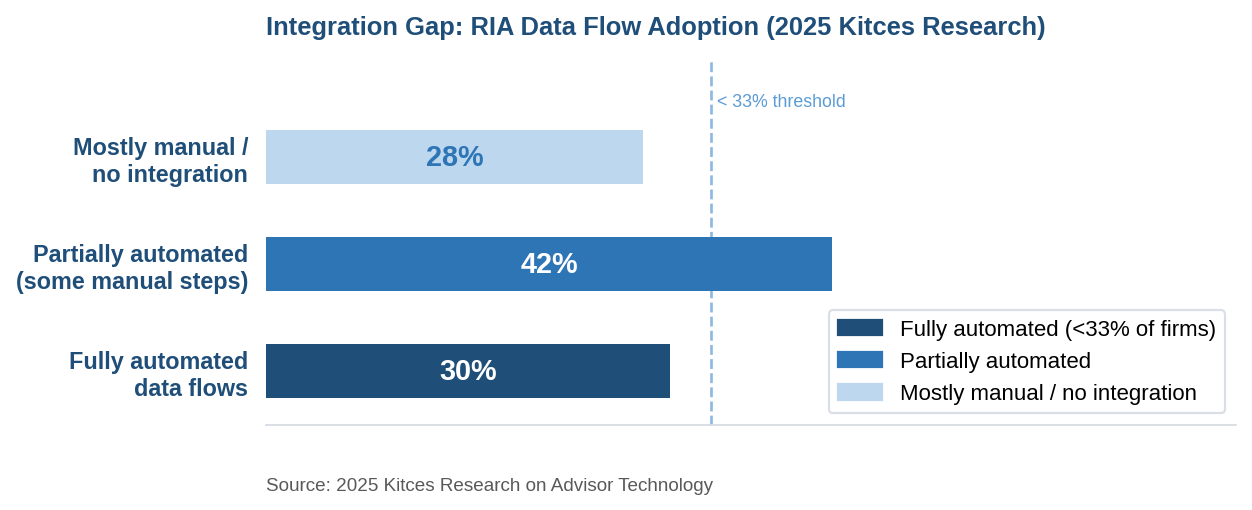
Figure 1: Integration Gap | RIA Data Flow Adoption (2025 Kitces AdvisorTech Report, Aug 2025)
10 Questions to Ask Any AI Vendor Before Signing a Contract
Ask all ten. Score the answers. Any vendor who deflects on more than two of these is not ready for production in your firm.
| 1. What does your integration architecture actually look like?
Ask them to describe specifically how they connect to Orion, Redtail, and Egnyte. Ask about data flow direction, latency, and what happens when a source system API changes. Check: Named connectors, tested integrations, rollback protocol |
| 2. What does “30-day deployment” actually include?
Get a written scope definition. Does it include integration testing, UAT, compliance sign-off, and security review? Or is day 30 the day they hand you a prototype that still needs 90 days of internal approvals? Check: Detailed week-by-week plan with your team’s time requirements listed |
| 3. Where does my data go, and who owns the model outputs?
Under GDPR and SEC Rule 17a-4, data residency and output ownership are non-negotiable. Ask: is client data used for model training? Is it retained after the contract ends? Check: Private VPC deployment, no cross-client training, data destruction clause |
| 4. Can you show me a full audit trail from a live client?
Ask the vendor to demonstrate live, not in a slide deck, how a compliance officer would trace an AI recommendation back to its source data, the model decision, and the human approval step. Check: Live demo with timestamped log and human-approval step visible |
| 5. What happens when the AI is wrong?
A mature vendor has a defined exception-handling workflow, human escalation path, and error rate SLA. An immature vendor will tell you the AI is “very accurate” and change the subject. Check: Defined error rate, escalation workflow, SLA on correction |
| 6. Who are your three most similar clients, and can I speak with their COO?
Not their happiest client. Not the one on their website. The three most similar to you by AUM, tech stack, and operational model. If they cannot produce three, they have not solved your problem before. Check: Unfiltered reference list with COO-level contacts provided |
| 7. What is your pricing model, and what does “scale” cost?
Get a three-year cost model, not just the implementation quote. Hidden scaling costs in per-seat models routinely double year-one quotes by year three. Check: Flat platform fee or outcome-based model with capped upside |
| 8. What is your model and what are its actual limitations?
“Proprietary model” often means a thin wrapper around a foundation model. Ask: which foundation model underpins this? What document types does it handle poorly? Check: Clear model lineage, documented limitations, ongoing fine-tuning protocol |
| 9. How does this integrate with my specific tech stack?
Bring your actual system list. Most wealth management firms run 15 to 25 tools. Ask the vendor to walk through your specific stack and identify every integration point. Check: System-by-system mapping, pre-built connectors for your core platforms |
| 10. What is your contractual definition of “production-ready”?
“Production-ready” must be defined in writing: connected to live systems, handling real data volumes, with compliance sign-off, operating within defined accuracy thresholds, with an active SLA. Get it in writing before you sign anything. Check: Defined acceptance criteria in contract, refund clause if milestones are missed |
Red Flags: What “Custom Build” and “Proprietary Model” Really Mean
Two phrases appear in almost every AI vendor pitch deck. Both are often misleading.
| “Custom Build for Your Firm” | “Proprietary Model” |
| In most cases, this means the vendor will take their standard product and configure it to your specifications. That is not a custom build. It is implementation.
A true custom build means you are funding development the vendor will re-sell to other clients. You are their R&D budget. Ask: is any code being written that does not exist in your current product? If yes, who owns the IP? What happens when you leave? |
In practice, the vast majority of wealth management AI tools are fine-tuned versions of foundation models with domain-specific prompting layers on top.
That is a legitimate approach, but it is not a proprietary model in any meaningful sense. Ask: which foundation model underpins this? What is your fine-tuning dataset? What is your model update cadence? |
What a Real PE-Specific Case Study Looks Like
A genuinely useful proof point includes all five elements below. If any are missing, discount the case study heavily.
| 01 | Comparable firm profile AUM range, tech stack, ops team size, and PE ownership structure must all be disclosed. A case study about a $50B bank tells you nothing about a $3B PE-backed RIA. |
| 02 | Quantified before-state “20 staff members spending 4 hours daily on manual data re-keying” is useful. “Manual processes were slowing us down” is not evidence. |
| 03 | Specific systems named Real integrations have names. If Orion, Egnyte, and Redtail are your stack, the case study must reference those systems specifically. |
| 04 | Time-bounded results “80% reduction in processing time, measured 60 days post-deployment, on live production data” is a proof point you can take to your investment committee. |
| 05 | Named, contactable executive The quote at the bottom must belong to someone whose LinkedIn profile you can find and whose phone number the vendor can provide. |
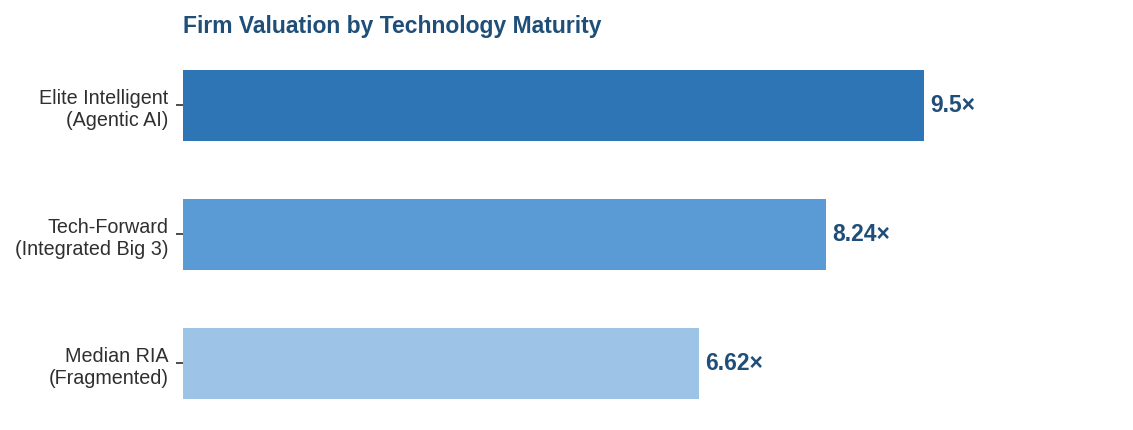
Figure 2: Firm Valuation by Technology Maturity Level | EBITDA Multiple (T3 Conference 2025, via Ezra Group)
Pricing Model Analysis
Three pricing models dominate the market. Each has a different risk profile for PE-backed firms optimising for margin expansion and exit valuation.
| Per-seat / Per-user | Platform / Outcome-based | Consumption / API call |
| Variable cost model
Costs scale with headcount. Incentivises the vendor to resist automation that reduces seat count, a structural misalignment. Watch: true-up clauses on headcount changes and PE-triggered M&A activity. |
Preferred for PE
Fixed fee or fees tied to measurable outcomes. Aligns vendor incentives with your operational goals. Easiest to model in a diligence process. Positive: predictable cost base, vendor has skin in your outcomes. |
Variable usage model
Costs tied to data volume or API calls. Unpredictable at scale, especially dangerous post-acquisition when data volumes spike suddenly. Watch: volume thresholds, price-per-call tiers, AUM-triggered re-pricing. |
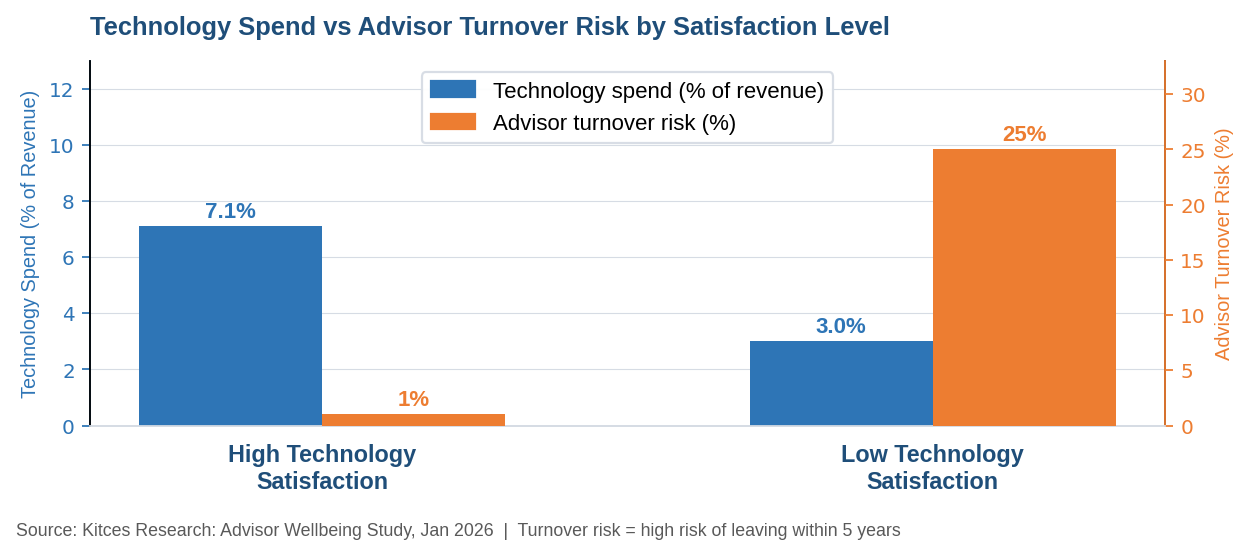
Figure 3: Technology Spend vs Advisor Turnover Risk | By Satisfaction Level (Kitces Research: Advisor Wellbeing Study, Jan 2026)
Implementation Timeline Reality Check
When a vendor says “30 days,” here is what the calendar often looks like, and what it should look like in a properly scoped engagement.
| What vendors often mean by “30 days” | What “30 days” should actually mean |
| Days 1 to 30: Working demo
A configured prototype on sandboxed data. Looks like production. It is not. The next 60 to 90 days involve security review, compliance sign-off, and integration work, all of which the vendor considers post-deployment. |
Days 1 to 30: Production-ready solution
Connected to live systems. Processing real data. Compliance-reviewed. Tested by your ops team. SLA active from day 31. Achievable only with a tightly defined scope and a vendor who has done it before. |
Week-by-week scope checklist. Demand this in writing before signing:
- Week 1 to 2: Workflow audit, integration mapping, use-case prioritisation
- Week 2 to 3: AWS/cloud deployment in your VPC, system integration builds
- Week 3 to 4: User acceptance testing with your ops team on live data
- Week 4: Compliance review, documentation, SLA activation
What is driving the wellbeing improvement?
The 2025 Kitces Research Advisor Wellbeing Study surveyed approximately 1,500 advisory team members and found that the technology stack is now the single largest driver of advisor wellbeing at the firm level, surpassing physical environment, compensation structure, and team dynamics. Advisors at firms with high technology satisfaction scores (9 to 10 out of 10) were nearly twice as likely to be classified as thriving compared to 2023, while the share of advisors classified as unwell dropped by more than a third.
The business implication is direct: wellbeing correlates with retention. Advisors at high-satisfaction firms carry only a 1% risk of leaving within five years, compared to 25% at low-satisfaction firms. For a PE-owned firm managing advisor talent through a hold period, this is not a wellness metric. It is an EBITDA risk factor.
| 22.5% of advisors now classified as thriving, up from 13.8% in 2023 |
7.3 / 10 average Cantril wellbeing score in 2025, up from 6.8 in 2023, above the US population average of 6.7 |
12.5% of advisors now classified as unwell, down from 20% in 2023 |
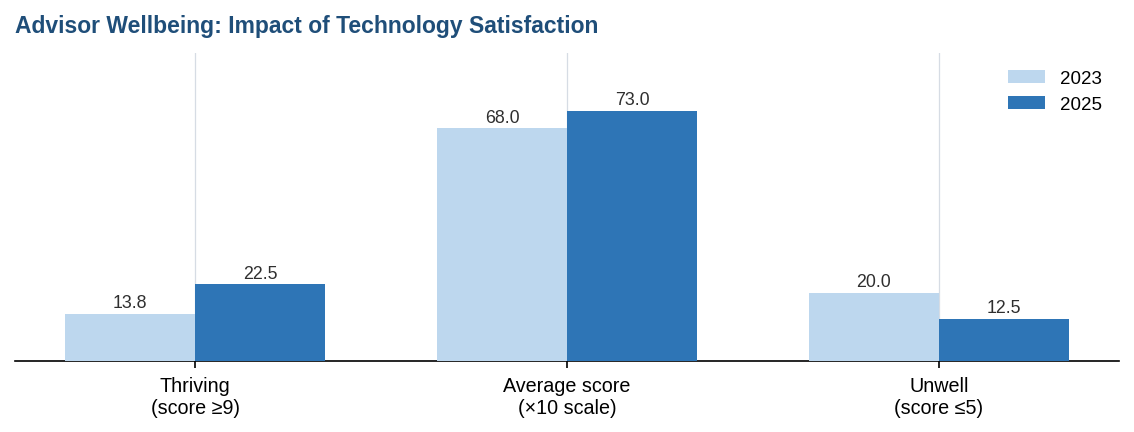
Figure 4: Advisor Wellbeing by Category | 2023 vs 2025 (Kitces Research: Advisor Wellbeing Study, Jan 2026)
The Reference Check Framework for AI Vendors
Most COOs run a single reference call and ask the wrong questions. References are pre-coached, not to lie, but to lead with the wins and deflect on the friction. Use this structured framework to extract the information you actually need.
| Category 1: The before-state | Category 2: Implementation reality |
|
|
| Category 3: Compliance and audit trails | Category 4: The honest scorecard |
|
|
| The single most important reference question: “What does your compliance officer think of this system?” If the reference contact cannot answer that, or has to go find out, the system has not been fully adopted at the firm level. |
What does ROI actually look like in production?
The following ranges are drawn from Digital Alpha client implementations across firms of different maturity levels. Results vary by firm size, data quality, and which stage of the four-stage maturity model the firm entered at. High-maturity firms at Stages 3 and 4 consistently achieve the upper end of each range. Early-stage firms at Stages 1 and 2 typically achieve the lower end within the first 90 days, with gains compounding as integration matures.
Source: Digital Alpha client implementations. Ranges reflect variation across firm maturity stages (Stage 1 to 4). Independent third-party verification not available.
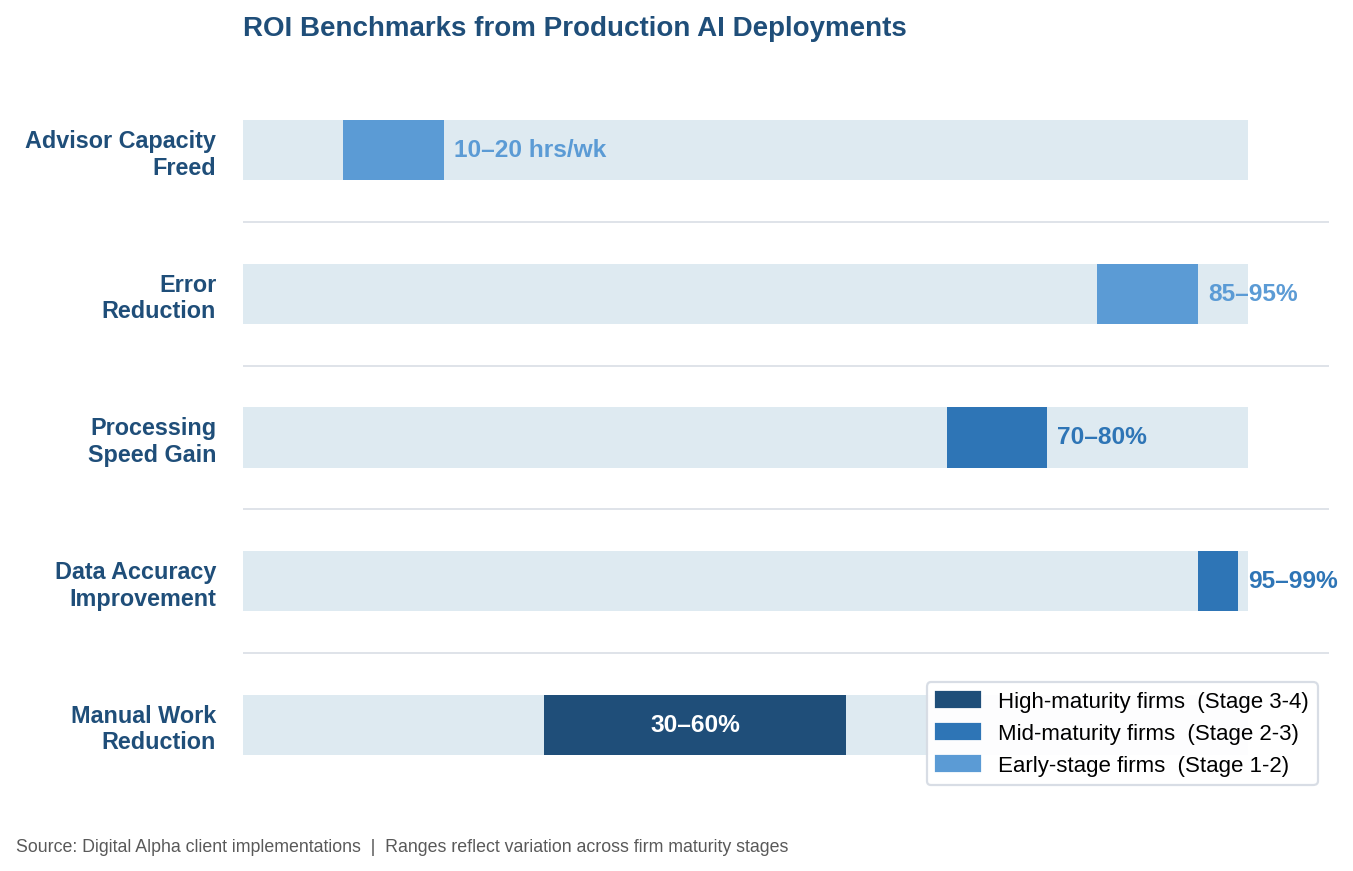
Figure 5: ROI Benchmarks from Production AI Deployments | Digital Alpha client data, by firm maturity stage
|
Ready to apply this framework to your firm? Digital Alpha’s 30-day AI Jumpstart starts with a vendor-neutral assessment of your current stack, before any technology decision is made. Book your 30-day Jumpstart call at digital-alpha.com |