Between 70% and 80% of enterprise AI pilots never reach production. In wealth management, fragmented data makes the odds steeper. This article examines what the research reveals about systematic failure and outlines the disciplined alternative that separates firms capturing real value from those burning capital on demos.
The Pattern No One Wants to Talk About
Budgets are up, vendor pitches are multiplying, and every conference keynote opens with an AI demo. Yet by every credible measure, most enterprise AI pilots fail before reaching production.
This is not a new observation. BCG and MIT Sloan documented the pattern in 2019, finding that seven in ten companies saw minimal or no impact from their AI investments. Five years and billions of dollars later, the numbers have worsened.
A 2024 RAND Corporation study placed the failure rate above 80%, which is double the rate for non-AI technology projects. Gartner’s most recent survey of 782 IT leaders found that only 28% of AI use cases fully meet ROI expectations. S&P Global reported that 42% of companies abandoned most of their AI initiatives in 2025, up from 17% the prior year.
For wealth management firms, where data fragmentation is structural and regulatory stakes run high, the odds are steeper still.
The question is no longer whether AI is valuable. It is whether your firm can build a pilot that survives contact with reality.
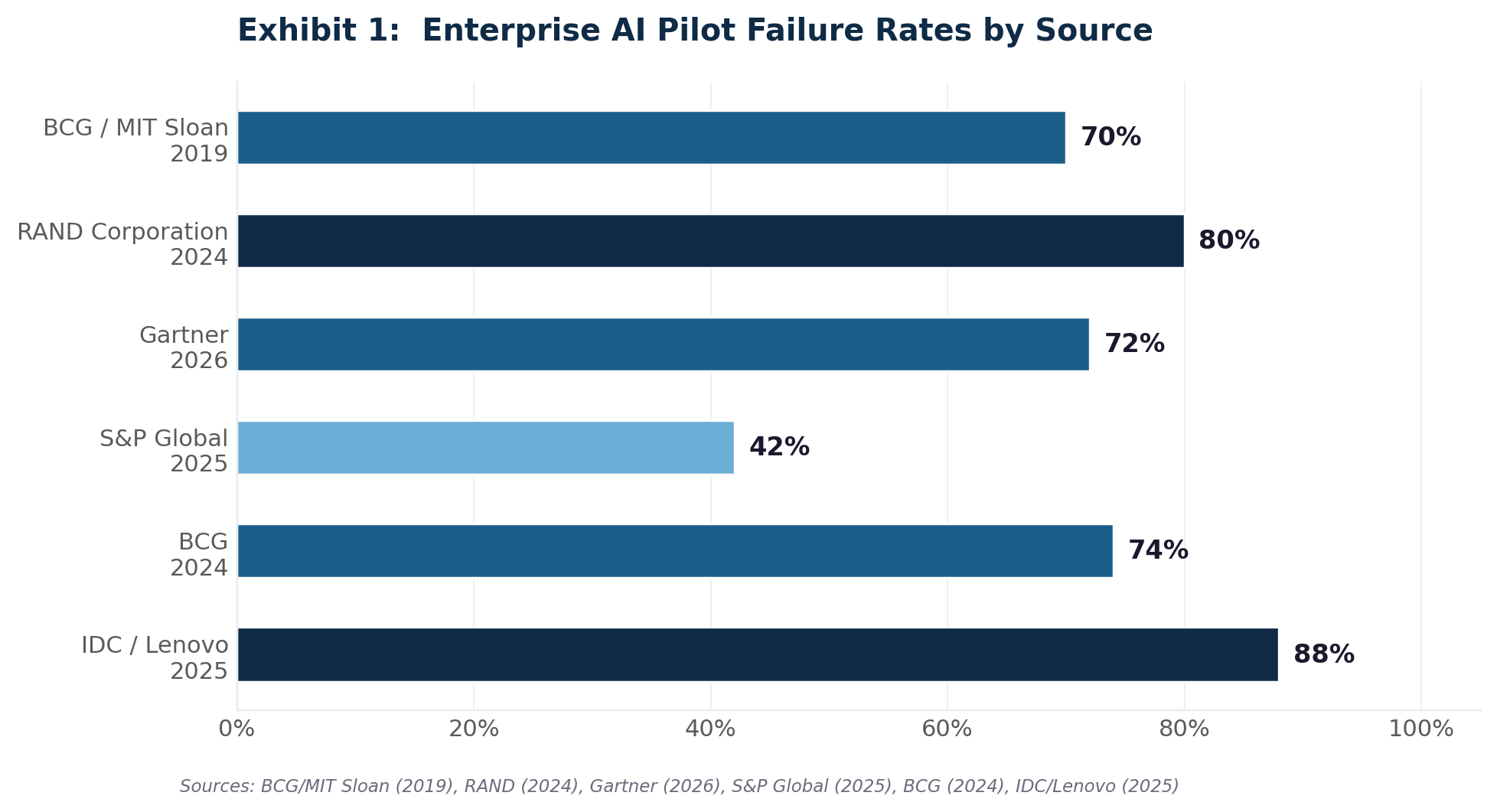
As seen in Exhibit 1, this is not an outlier statistic from a single study. Six independent research institutions, using different methodologies and different sample sizes, converge on the same finding: the majority of AI pilots do not deliver.
Root Cause #1: Building on a Broken Data Foundation
The single most cited reason for AI pilot failure is not bad models or bad algorithms. It is bad data.
A 2025 Forrester and Capital One survey of 500 enterprise data leaders found that 73% identified data quality and completeness as the primary barrier to AI success. Gartner surveyed 248 data management leaders and predicted that organizations will abandon 60% of AI projects unsupported by AI-ready data through 2026. A joint HBR Analytic Services and Cloudera study found that only 7% of enterprises consider their data completely ready for AI.
Seven percent.
In wealth management, the problem is structural. A typical RIA operates 15 to 25 technology tools spanning portfolio management, CRM, document management, financial planning, billing, and compliance. The 2025 Kitces AdvisorTech Study, surveying over 700 advisors, confirmed that integration remains the single largest driver of technology satisfaction. Yet fewer than one-third of advisors report that data flows automatically across their main applications.
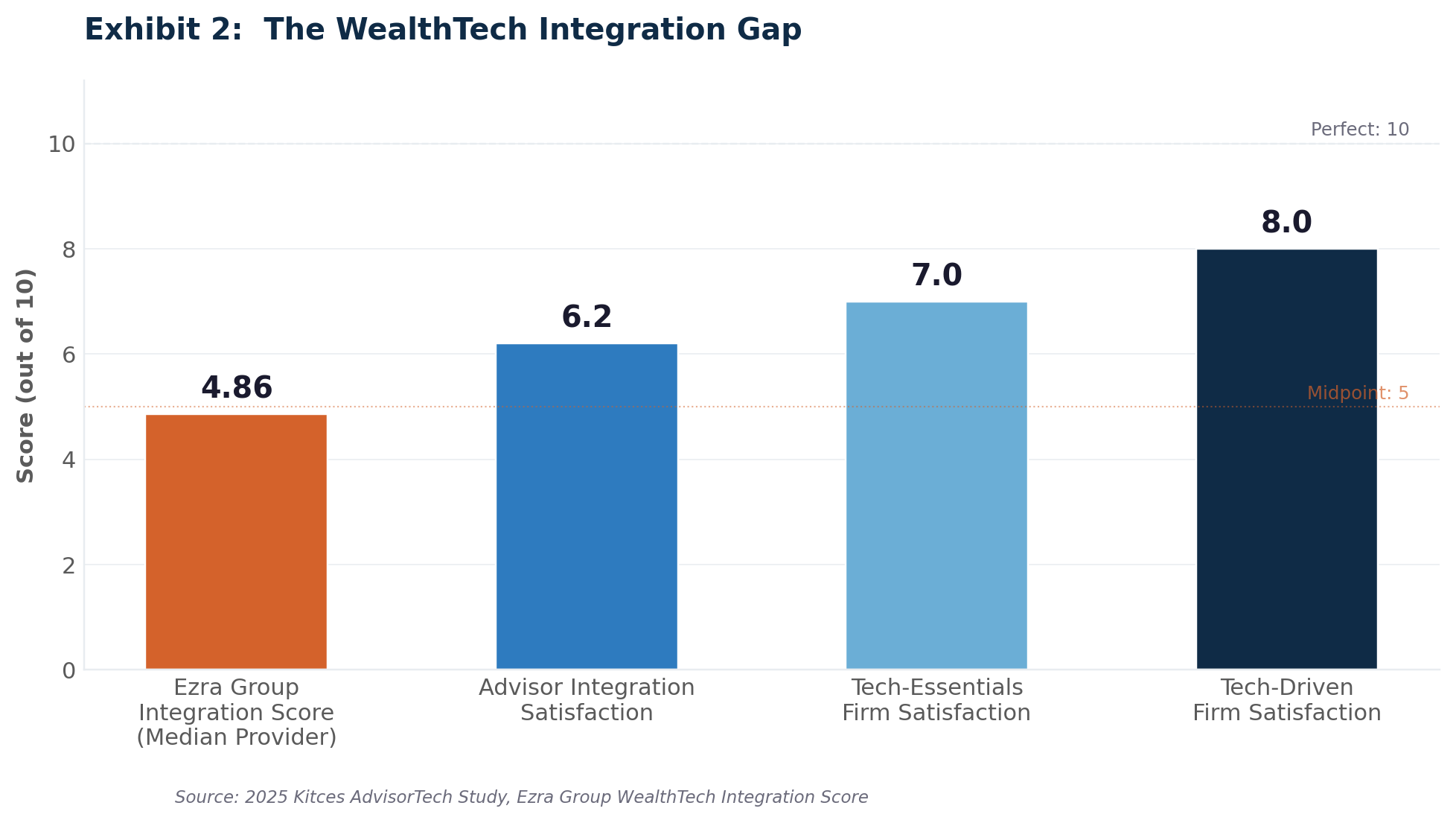
Exhibit 2 quantifies the gap. The Ezra Group’s WealthTech Integration Score, a standardized measure of API depth and quality across more than 550 applications, rates the median technology provider at just 4.86 out of 10. Integration satisfaction among advisors sits at 6.2. The gap between firms that have prioritized integration (“Tech-Driven” at 8.0) and those that have not (“Tech-Essentials” at 7.0) is measurable and consistent.
| Adding AI to a fragmented tech stack is like installing a high-performance engine in a car with no transmission. The power is there, but it cannot be translated into motion. |
When a firm layers AI on top of disconnected systems, where client data lives in one CRM, portfolio data sits in a separate platform, and documents are stored in a third repository, the AI has no coherent foundation to reason from. The result is what industry observers call “automation theater”: impressive demos that collapse in production because the underlying data is unreliable.
Root Cause #2: Choosing the Wrong First Use Case
The second pattern that kills AI pilots is ambition misaligned with infrastructure. Firms select use cases that are too complex, too cross-functional, or too far removed from measurable business outcomes.
BCG’s research makes the point sharply. Their analysis found that AI leaders generate 62% of their value from core business processes, not from peripheral support functions. Yet most organizations begin with the opposite: broad, exploratory projects in areas like “general productivity” or “innovation initiatives” that lack defined success criteria.
The MIT Project NANDA study reinforced this finding. Back-office automation produces the highest returns. Sales and marketing pilots show the lowest ROI. The study also found that specialized vendor-led projects succeed roughly 67% of the time, compared to only 33% for internally built solutions.
The first use case should be narrow, high-volume, rules-based, and connected to a specific operational bottleneck.
In wealth management, the highest-impact starting points include document reconciliation between portfolio management systems and document storage, fee and billing validation against client agreements, and security identifier normalization across custodians. Each is repetitive, error-prone, and consumes significant operations team time.
Root Cause #3: The Trust Gap Kills Adoption
Even well-built AI pilots fail when the people expected to use them do not trust them. And trust in AI is declining.
The Edelman Trust Barometer found that global trust in AI companies dropped from 61% to 53% in 2024. In the United States, trust fell by 15 points. Only 27% of organizations now trust fully autonomous AI agents, down from 43% one year earlier. Nearly half of enterprise AI users made at least one major decision based on hallucinated content in 2024.
For wealth management, the stakes are personal. As Michael Kitces has noted, advisors handle clients’ life savings. Even 99% accuracy means one wrong call per year for a typical advisor, and that single error can destroy a client relationship or trigger regulatory action. The Kitces research found that automating client-facing interactions was the least appealing AI capability to advisors.
Advisors want AI to accelerate their work, not to replace their judgment.
This is why human-in-the-loop design is not optional. It is a structural requirement. Every AI output must be explainable, reviewable, and auditable. The firms succeeding with AI adoption have embedded it into existing workflows with clear approval gates, rather than deploying it as a standalone tool operating outside the advisor’s control.
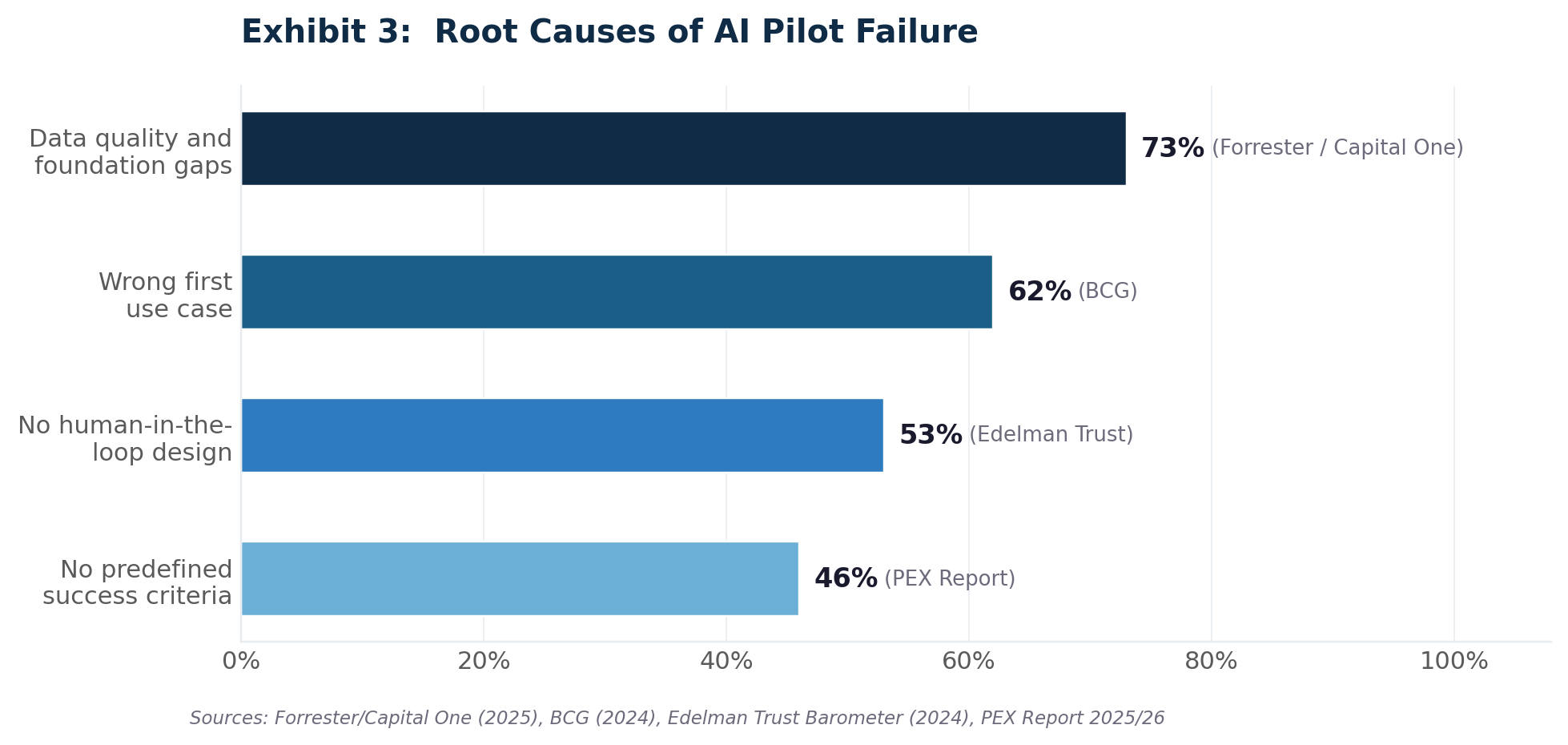
Exhibit 3 maps the root causes by the percentage of organizations citing each as a primary barrier. Data quality dominates. But the trust gap and the absence of predefined metrics follow close behind, indicating a systemic problem rather than an isolated technical failure.
Root Cause #4: No Defined Success Criteria Before Launch
The final pattern is also the most avoidable: launching an AI pilot without defining what success looks like.
McKinsey reports that fewer than one-fifth of organizations using AI track KPIs that tell them whether it is working. An IDC survey found that nearly half of CIOs do not know if their AI production applications are successful. The PEX Report 2025/26 found that only 34% of respondents consider AI initiatives fully aligned with business goals.
The data on this point is unambiguous.
Compiled analysis from Pertama Partners shows that projects with clear pre-approval metrics achieve a 54% success rate versus 12% without. That is a 4.5x difference. Sustained executive sponsorship correlates with 68% success versus 11%. Organizations that treat AI as business transformation see 61% success versus 18% when treated as an IT project.
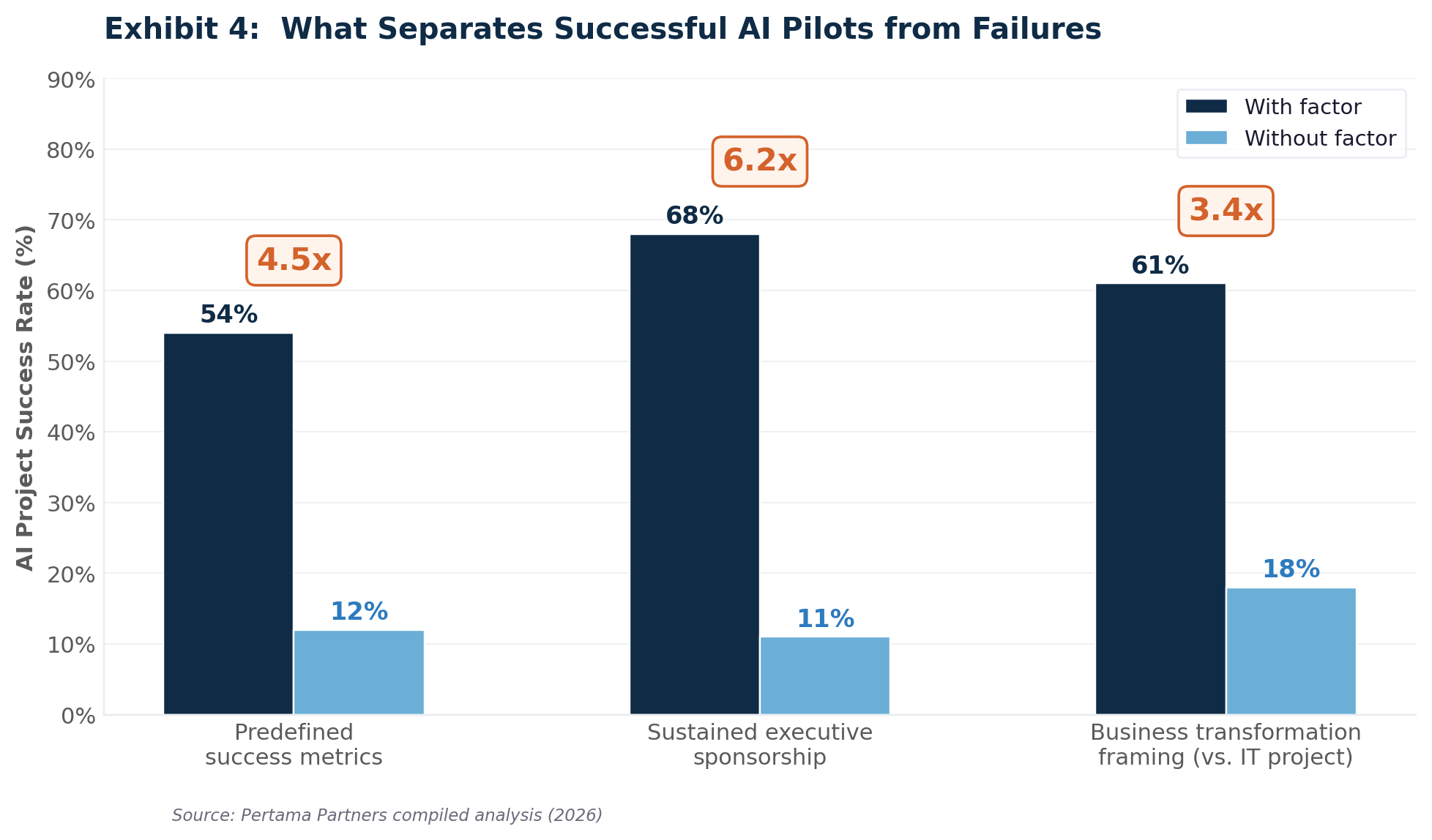
Exhibit 4 makes the contrast stark. The multiplier effect of proper scoping, including defined metrics, executive sponsorship, and business-led framing, is not marginal. It is the difference between a project that delivers and one that gets quietly shelved after six months.
The Four-Stage Maturity Model: A Disciplined Alternative
The research is clear on what goes wrong. The next question is what the disciplined alternative looks like.
The Intelligent Operations Playbook uses a four-stage maturity model that sequences technology investments in the order that works. Firms do not need to reach the final stage to capture significant value. Each stage delivers measurable ROI independent.
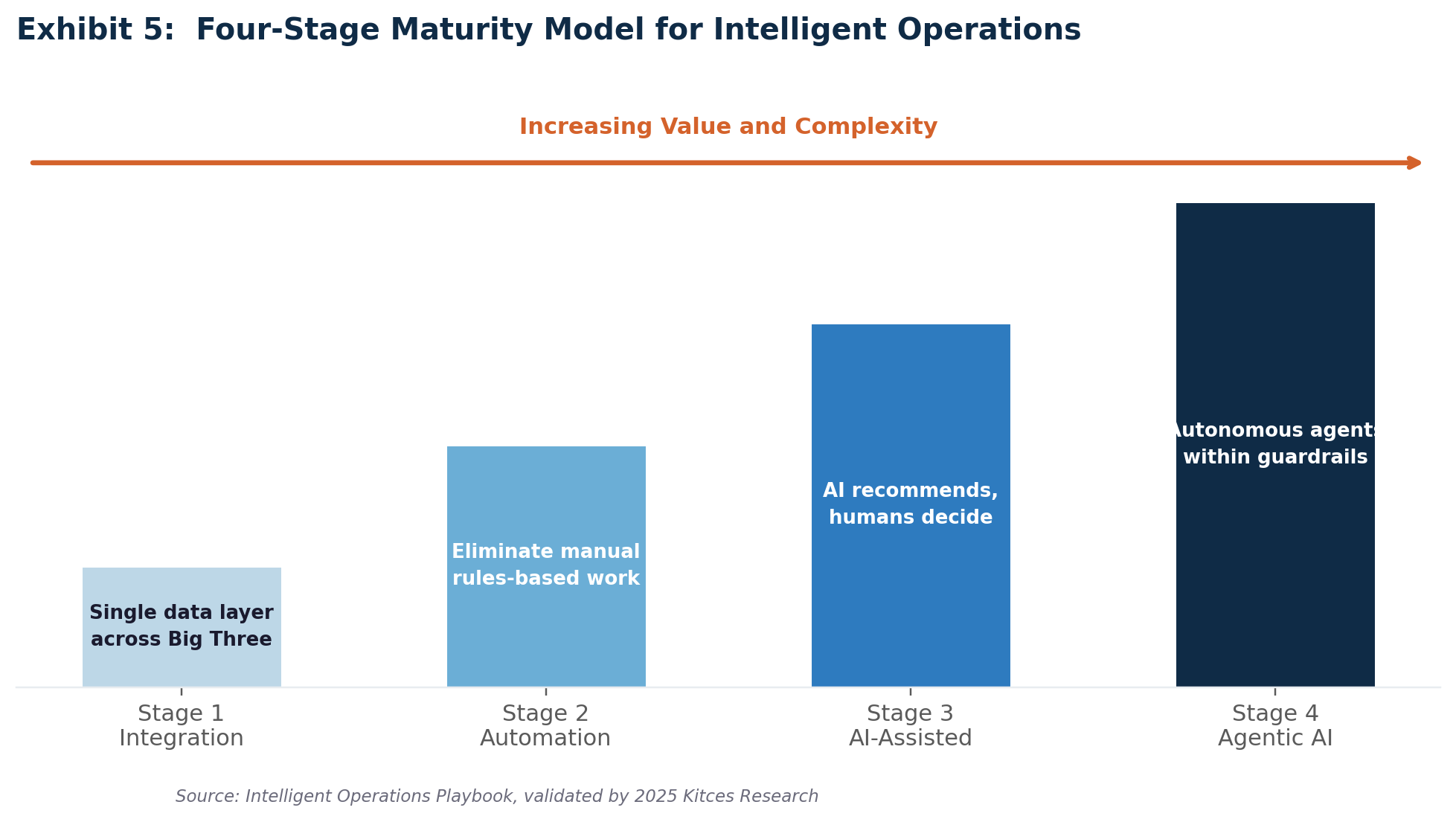
Stage 1: Integration. Build a single, reliable operational data layer across the “Big Three” systems: CRM, financial planning, and portfolio management. This eliminates manual reconciliation and gives every downstream system a shared source of truth. The 2025 Kitces Research confirms that firms prioritizing data integration achieve a 25% improvement in advisor experience. Those that skip to AI end up managing broken automations.
Stage 2: Intelligent Automation. Once data flows freely, automate repetitive, rules-based work: document classification, data validation, fee calculations, and exception detection. Case studies demonstrate 30% to 60% reductions in manual operations effort and accuracy improvements above 95%.
Stage 3: AI-Assisted Workflows. Introduce AI to surface recommendations for human review. The principle is straightforward. AI assists humans. Humans retain control. Use cases include meeting preparation summaries, intelligent exception explanations, and compliance report generation with cited sources.
Stage 4: Agentic AI. Deploy autonomous agents that monitor data continuously, reason over changes, take predefined actions within guardrails, and escalate only when human judgment is required. This stage requires the maturity of Stages 1 through 3 as its foundation.
| The firms commanding 8.24x EBITDA multiples are not the ones with the most AI tools. They are the ones with integrated data, disciplined automation, and AI deployed where it meaningfully reduces friction. The median firm, stuck in fragmentation, trades at 6.62x. |
What a Production-Ready AI Pilot Looks Like
The following checklist distills the patterns that separate the 28% of AI pilots that succeed from the 72% that do not.
Before You Build
- Integration baseline confirmed: Big Three systems (CRM, portfolio management, financial planning) share a single data layer with automated sync.
- Use case is narrow, high-volume, and rules-based (e.g., document reconciliation, fee validation, identifier normalization).
- Success criteria are defined and agreed upon before development begins (e.g., processing time reduction, accuracy rate, hours saved per week).
- An executive sponsor is named and committed to the 30-day timeline.
- Compliance and audit trail requirements are documented from day one.
During the Pilot (30 Days)
- Weeks 1 to 2: Discovery, workflow assessment, system integration mapping, and agent architecture design.
- Weeks 2 to 3: Build and configure within your infrastructure (private VPC). Connect to live systems such as Orion, Egnyte, and Redtail.
- Week 4: User acceptance testing with real users in real workflows. Training sessions. Production deployment with monitoring.
After Launch
- Human-in-the-loop design confirmed: every AI output is reviewable and auditable.
- A 90-day roadmap is in place for scaling across departments based on pilot results.
- ROI measurement baseline established. Target: 30% to 60% reduction in manual operations, 10+ hours per week saved per advisor.
The evidence supports this approach. AWS’s Generative AI Innovation Center reports that 65% of customer projects moved from concept to production using a structured rapid-pilot methodology. Some launched in as few as 45 days. Bain found that 34% of cancelled bank AI programs would have achieved positive ROI within six months of cancellation. The problem is not the technology. It is the pace and discipline of validation.
Reference Data
Table 1: AI Pilot Failure Rates by Source
| Source | Finding | Rate | Year | Sample |
| BCG / MIT Sloan | Minimal or no AI impact | 70% | 2019 | 2,500+ executives |
| RAND Corporation | AI project failure rate | 80%+ | 2024 | 65 data scientists |
| Gartner | Use cases not meeting ROI | 72% | 2026 | 782 I&O leaders |
| S&P Global | Companies abandoning AI | 42% | 2025 | 1,006 professionals |
| BCG | Struggling to scale value | 74% | 2024 | 1,000 CxOs |
| IDC / Lenovo | Pilots not reaching prod. | 88% | 2025 | Enterprise survey |
Table 2: Wealth Management Integration Data
| Metric | Value | Source |
| Firms with automated data flows | <33% | 2025 Kitces Research |
| Ezra Group integration score (median) | 4.86 / 10 | Kitces / Ezra Group |
| Integration satisfaction (advisors) | 6.2 / 10 | 2025 Kitces Research |
| RIAs using AI tools | 63% | Schwab RIA Study (Oct 2025) |
| Advisors using GenAI (2026) | 52% | T3 / Inside Information |
| Tech-forward firm EBITDA multiple | 8.24x | WealthTech Today |
| Median firm EBITDA multiple | 6.62x | WealthTech Today |
Table 3: Success Factors
| Factor | With | Without | Multiple | Source |
| Predefined success metrics | 54% | 12% | 4.5x | Pertama |
| Executive sponsorship | 68% | 11% | 6.2x | Pertama |
| Business transformation framing | 61% | 18% | 3.4x | Pertama |
The Uncomfortable Truth
The AI pilot failure problem will not solve itself. Budgets will keep growing. Vendor pressure will intensify. The temptation to skip foundational work and chase the latest tool will remain strong.
But the data is clear.
The firms capturing real value from AI, saving 50+ hours per week, achieving 95% accuracy improvements, and commanding premium valuations, share a common trait. They did the integration work first. They started with narrow, high-impact use cases. They defined success criteria before writing a single line of code. And they designed for human oversight from day one.
The path forward is not to abandon AI. It is to sequence it correctly.
Integration before intelligence. Discipline before ambition. A 30-day pilot with clear metrics before a multi-year transformation.
Key Takeaways
- Between 70% and 80% of AI pilots fail across every credible source. In wealth management, fragmented data makes the odds worse.
- Data quality is the number one barrier. Only 7% of enterprises have AI-ready data. Fewer than 33% of advisory firms have automated data flows.
- Predefined success metrics increase AI project success by 4.5x. Executive sponsorship increases it by 6.2x.
- Integration must come before AI. The four-stage maturity model (Integration, then Automation, then AI-Assisted, then Agentic) is the disciplined path.
- Tech-forward firms trade at 8.24x EBITDA versus 6.62x for median firms. The ROI of sequencing correctly is not operational. It is existential.
AI does not fail because the technology is bad. It fails because the foundation is not there.