Imagine hiring a brilliant new analyst, sharp, fast, and tireless. But on their first day, you realize your filing system is a mess. Client records are scattered across four different spreadsheets; your CRM has different numbers than your portfolio tool, and nobody really knows which system has the right answer. Would that analyst make you more productive? Or would they just surface errors faster?
That is the problem with how many wealth management firms are approaching artificial intelligence right now. The tools are impressive. But the foundation they’re being built on is cracked.
Every year, Michael Kitces and his team survey hundreds of independent financial advisors about the technology they actually use and how satisfied they are with it. The 2025 edition landed with a clear, uncomfortable message: the single biggest driver of technology satisfaction isn’t AI. It’s integration the invisible plumbing that connects systems together, so data flows automatically. And most firms still don’t have it.
| NEW TO THIS SPACE? A few terms worth knowing:
• RIA (Registered Investment Advisor): A firm or individual that manages investments and provides financial advice. • AUM (Assets Under Management): The total value of client investments a firm oversees. • CRM (Customer Relationship Management): Software that tracks client interactions and stores contact information. Think of it as the advisor’s memory system. |
Integration Drives Satisfaction
The 2025 Kitces AdvisorTech Report surveys independent financial advisors on every major technology category. Year after year, one variable consistently predicts how satisfied an advisor is with their technology stack more than any other.
Not AI tools. Not the number of platforms. Integration whether key systems share data automatically.
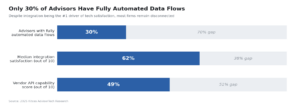
Figure 1: The Integration Gap where most wealth management firms actually stand today
Read those numbers again. Despite integration being the top predictor of satisfaction, fewer than one in three advisors actually has it. The median technology provider scores less than five out of ten on API capabilities. The average advisor’s satisfaction with integration sits at just 6.2 out of ten.
This is not a feature gap. It is a structural gap. And firms adding AI on top of this gap are not solving it they are accelerating into it.
The Integration Gap
To understand why this matters, picture what a fragmented technology stack looks like inside a real firm. A typical independent RIA runs somewhere between 15 and 25 software tools. Each one was chosen because it does its specific job well. But ‘best of breed’ rapidly becomes ‘worst of experience’ when those tools don’t talk to each other.
How Advisors Actually Spend Their Time
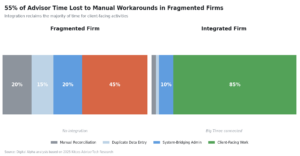
Figure 2: Time allocation comparison fragmented vs. integrated firm. Based on Digital Alpha analysis of 2025 Kitces data
The Symptoms of Fragmentation
- Duplicate Data Entry
The same client information is entered separately into the CRM, financial planning tools, and portfolio management systems, leading to redundancy and increased risk of inconsistencies. - Manual Reconciliation
Data is extracted from multiple systems and compared manually, resulting in frequent discrepancies, delays, and reduced information reliability. - Spreadsheet Dependency
In the absence of reliable integrations, Excel becomes an informal integration layer, creating version control issues and increasing audit and operational risks. - Advisor Time Drain
Highly compensated advisors spend significant time on repetitive administrative tasks that could be automated, reducing overall productivity and client-facing time. - Compliance Gaps
Audit trails reliant on manual documentation are often incomplete or inconsistent, exposing the organization to compliance risks and potential liabilities.
| “AI didn’t break your operations. It just made the cracks obvious.” |
This is the ‘Silent Operational Tax.’ It doesn’t show up as a line item on a budget. But it accumulates every day in wasted hours, data errors, and decisions made on stale information. Research suggests a 100-client firm switching technology providers spends approximately two hours per client on data migration and reconciliation roughly five weeks of full-time labor.
Why Integration Matters
Let’s flip the picture. What does high integration actually look like in practice?
In a well-integrated firm, when an advisor opens a client record, they see a single complete view: current portfolio values from the portfolio management system, the latest financial plan, recent communications from the CRM, and any open tasks all in one place, all current, all accurate. Nothing was manually updated. The data just flows.
The Business Impact: Advisor Wellbeing
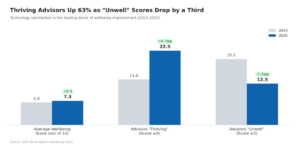
Figure 3: Advisor wellbeing improved significantly between 2023 and 2025 driven largely by technology satisfaction gains. Source: 2025 Kitces Advisor Wellbeing Study.
Wellbeing improvement isn’t just a ‘nice to have.’ Firms with high technology satisfaction see only 1% of advisors at high risk of leaving over the next five years, versus 25% at low-satisfaction firms. That’s a 25x difference in retention risk which translates directly into recruitment costs, client relationship disruption, and lost AUM.
The Business Impact: Firm Valuation
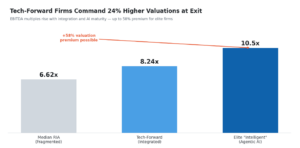
Figure 4: Technology maturity drives measurable valuation premiums at exit. Tech-forward integrated firms command 8.24x EBITDA vs. 6.62x for fragmented firms.
Integration is not an operational convenience. It is a strategic asset. The gap between a tech-forward firm and a median firm in terms of EBITDA multiple represents millions of dollars in enterprise value a difference that compounds over time.
The Big Three Systems
Not all integrations are equally valuable. The Kitces research is specific about where to focus: three core platforms form the operational backbone of every RIA, and getting those three to share data reliably is the foundational requirement for everything else.
| The “Big Three” Systems Every RIA Needs Connected
1. CRM (Customer Relationship Management): Redtail, Wealthbox, Salesforce. The system of record for all client relationships, communications, and compliance documentation. If your CRM data isn’t reliable, every downstream process is compromised. 2. Financial Planning Software: eMoney, RightCapital, MoneyGuide. The platform for goal-based planning, scenario modeling, and tax projections. 3. Portfolio Management System: Orion, Tamarac, Black Diamond. The engine for account aggregation, performance reporting, and rebalancing. |
How the Planning Software Market Actually Stacks Up
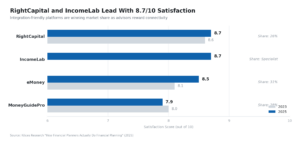
Figure 5: Financial planning software satisfaction scores and market share (2023 vs. 2025). RightCapital leads with 8.7/10. Source: Kitces Research ‘How Financial Planners Actually Do Financial Planning’ (2025).
Right Capital’s rise from 10% market share in 2018 to 26% in 2024 is partly driven by integration-friendly design and tools that reduce switching costs. Platforms that make data portability easy are winning, because the market is beginning to reward connectivity over complexity.
AI Needs Integration First
Here is the argument the 2025 research makes clear, and that most vendors won’t make because it’s bad for sales: adding AI to a fragmented technology stack doesn’t fix the fragmentation. It exposes it.
What AI Actually Needs to Work
Consider what a genuinely useful AI meeting preparation tool requires:
- Current account values and recent performance from the portfolio management system
- Up-to-date planning projections and goal progress from the financial planning platform
- Client interaction history and open action items from the CRM
- Life events, risk profile changes, and compliance notes reconciled across all three
If those four inputs are fragmented, the AI doesn’t generate insight. It generates noise. Advisors end up manually correcting AI outputs, which is worse than doing the prep manually in the first place, because now there’s an added layer of AI-generated errors to catch.
| “Adding AI to a fragmented tech stack is like installing a high-performance engine in a car with no transmission. The power is there but it can’t be translated into motion.”
– Rajesh Damarapati |
Four out of five advisors surveyed said they’re not using technology to get faster and cheaper they’re using it to get better. Deeper client relationships. Higher-touch service. Better outcomes. AI has a genuine role to play in that. But only on a foundation that supports it.
The 4-Stage Roadmap
The good news: this is not an all-or-nothing transformation. A phased approach means each stage delivers measurable value, and each stage builds the foundation for the next.
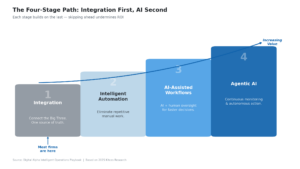
Figure 6: The four-stage maturity model from Integration to Agentic AI. Each stage builds on the last. Source: Digital Alpha Intelligent Operations Playbook, based on 2025 Kitces Research
Most firms attempting to move directly to Stage 3 or Stage 4 are building on an unstable Stage 1. The architecture doesn’t support it. The ROI doesn’t materialize. And advisors become cynical about AI because the tools don’t deliver what was promised.
AI notetakers, one of the most widely adopted AI tools in wealth management, offer a useful illustration. They’ve proliferated to over a dozen advisor-specific solutions. But analysts note they can’t compensate for low CRM adoption or unclear data ownership. The notes are taken. Intelligence goes nowhere.
30-Day Integration Plan
A focused 30-day sprint concentrated on the right integration gaps can close the most consequential bottlenecks and establish a foundation for AI. Here is what that sprint actually looks like:
Week 1 Assess and Map
- Document every platform in the tech stack and identify which pairs share data today
- Measure the manual burden how many advisor hours per week are spent on reconciliation and data entry?
- Identify the Big Three and evaluate the current state of connections between them
Week 2 Design the Integration
- Evaluate native integrations within existing platforms first many have improved substantially in 2024-2025
- Design the data mapping which fields need to sync, in which direction, with what validation rules?
Week 3 Build and Test
- Activate the integration and configure data flows in a test environment
- Run parallel processing manual and automated side by side to validate accuracy before going live
Week 4 Deploy and Measure
- Full deployment with training for advisors and operations staff on new workflows
- Establish baseline metrics – time saved per advisor per week, data error rate, onboarding cycle time
| What This Delivers
• 30–60% reduction in manual operational work • 95–99% accuracy improvement in data synchronization • 10+ hours per week per advisor redirected from administration to client work • A foundation that makes AI tools actually work as advertised |
Case Study: RIA Firm
Client is a nationally recognized RIA managing over $15 billion in assets across more than 7,900 clients. Their story makes the stakes concrete.
The Problem
Prospective clients arrived with financial statements in imperfect formats scans, faxes, PDFs with handwritten notes. Before advisors could analyze a portfolio, nearly 20 team members manually reviewed those documents and re-keyed data: cost basis, unrealized gains, asset allocation, account types.
| “Advisors spent hours on repetitive data entry instead of higher-value work such as portfolio construction, client strategy, and relationship development.” |
The Solution: Integration First, AI Second
The firm implemented Powder’s document intelligence integrated directly with Nitrogen’s portfolio analytics. Powder’s AI pipeline digitizes and interprets financial statement data even from low-quality scans and formats it into structured output. With a single click, parsed data flows into Nitrogen for immediate risk analysis and proposal modeling.
Notice the sequence: the integration came first. The AI capability was built on top of a connected workflow, not dropped into a fragmented one.
The Results
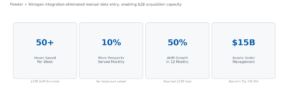
The operational efficiency also enabled firms‘s largest acquisition to date which is a $2 billion practice supporting a goal of $25 billion AUM within 18 months. Integration didn’t just save time. It created the capacity to grow.
| “An advisor received seven redacted statements from an $8M prospect for a meeting the very next day. We dropped them into Powder and delivered a fully built, client-specific proposal in hours. We exceeded expectations, looked like superheroes, and won the client.”
– $15B AUM RIA firm |
Key Takeaway
The 2025 Kitces research doesn’t leave a lot of room for interpretation. Integration is a prerequisite, and AI is a multiplier. Firms that skip the first step don’t get the second step to work.
Before your firm invests another dollar in AI tools, answer these three questions honestly:
| 1. Do your Big Three systems CRM, financial planning, and portfolio management share data automatically, in real time, in both directions?
If the answer is no, that’s your integration gap. 2. How many advisor hours per week are currently consumed by manual reconciliation, duplicate data entry, and system-bridging workarounds? That number is your operational tax. 3. If those hours were redirected to client-facing activities, what would that be worth in revenue, retention, and capacity? That’s the ROI available without buying a single new tool. |
If the answers reveal integration gaps and for most firms they will close them first. Not because AI isn’t valuable, but because a firm with clean, connected data and AI is dramatically more powerful than a firm with AI alone.
The firms that will lead this industry over the next decade are not necessarily the ones that adopted AI earliest. They are the ones that built the foundation that makes AI work.
About Digital Alpha
Digital Alpha partners with RIAs, broker-dealers, and wealth management firms to design and implement technology strategies that drive operational efficiency and enable growth. Our integration-first methodology grounded in the 2025 Kitces research ensures that AI and automation investments deliver measurable results. Programs available for firms from $500M to $20B+ AUM, with production-ready implementations in 30–90 days.
Learn more: digital-alpha.com/capital-markets